
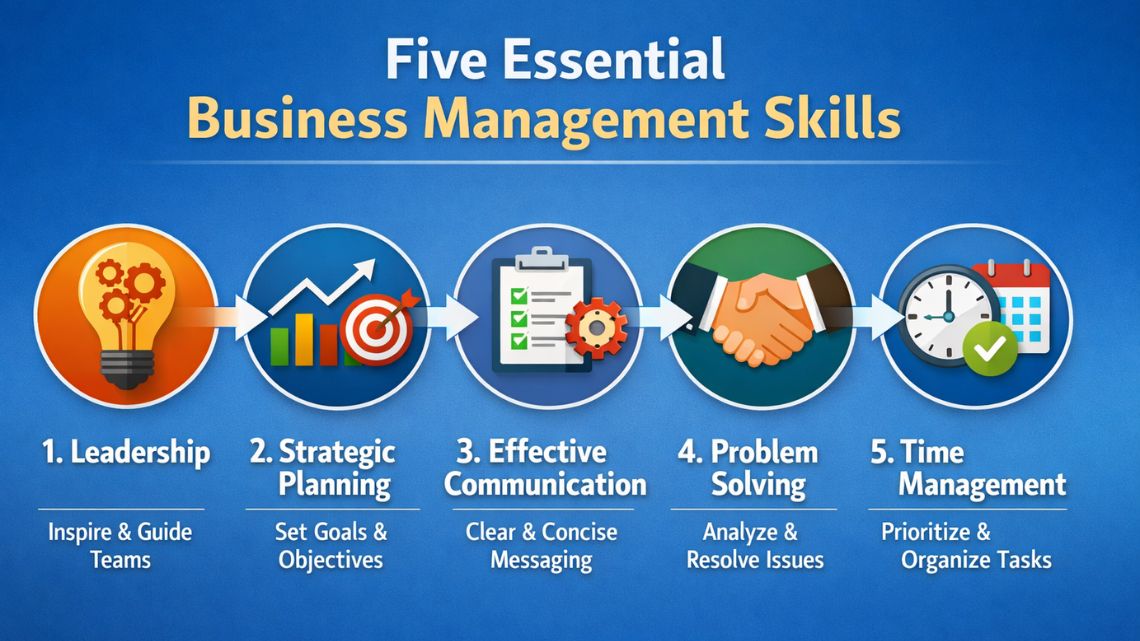
In the past decade, executive leadership has changed fundamentally, it is no longer assessed primarily on operational efficiency or a rigid hierarchy of control. Beyond supervision and streamlined operations, a leader must now create synergy across the many components of their organization, including people, processes, capital and technology. Therefore, effective management skills are indispensable to develop resilient, growth-enabling organizations.
In today’s fast pace and highly competitive business environments, management cannot be viewed as a generic competency but a fundamental capability for sustaining business stability over time. Leaders who embrace the shift toward modern management skills rather than rigid control driven governance will achieve competitive advantage to strategically pivot organizational growth and sustainability. This blog explores the five critical business management skills that define effective executive leadership.
Why Effective Management Skills Matter More Than Ever
Management skills have transitioned from merely supervision and more about one of the fundamental drivers of organizational resilience. The decisive factors of its importance are:
- Drive Organizational Performance
Management owns the initial accountability for employee engagement, which directly influences retention and productivity effectiveness. In contrast to the assessment metrics, leadership alignment is pivotal to translate tangible organizational outcomes rather than isolated functional excellence. Organizations that ensure strong management support not only lays the groundwork for workforce efficiency but seamlessly achieves financial targets and better profit margins.
- Foster Talent and Culture
In a market precedingly experiencing talent scarcity and challenges such as evolving workforce expectations, the company reputation is shaped by how the governing management across the company attract, retain and mobilize high performing workforce. Effective management has a critical impact on orchestrating harmony and alignment, instrumental to achieve success and business growth in today’s modular ecosystems.
Through embracing a human-centric leadership approach and allowing skill based support, managers can improve workforce potential and innovation. Transitioning to a more empathetic, inclusive and transparent architecture to management method, rather than the outdated control and hierarchy centered leadership, enable organizations to naturally evolve and align to the modern management benchmarks.
- Enable Strategic Decision-Making
Effective management skills are essentials to demonstrate a leadership transcending intuition and guesswork and with strategic contingency plans, equip teams to anticipate future trends, challenges and unprecedented disruptions. Particularly, in order to navigate today’s complexities of volume, ambiguity and speed, the management’s clarity in synthesizing insights and promoting data backed decisions instead of reactivity under immediate pressure is important.
Integrating tech-tools for analysis and forecast will enable managers to track vulnerabilities early on, and help them make informed decisions for the long term.
5 Business Management Skills That Define Successful Leaders
- Strategic Vision and Adaptive Thinking
The executive strategy is an evolving and dynamic model that identifies capabilities that can be modified based on changes in the marketplace, competition and technological advancements. Executive leadership must have a clear long-term vision and the capability to revise the method of achieving their vision, positioning and sustainable marketing as the competitive landscape shifts.
A critical part of this objective is systemic thinking—understanding of how actions taken in one part of the organization will affect other facets. In order to cultivate influence on the strategic direction, executives must continue to test their assumptions, identify and revise the priorities of business targets, and assure that their strategy is achievable and concrete.
- Financial Acumen and Value Optimization
The chief financial officer or CEOs alone is no longer the sole leader where financial intelligence resides. Today’s leaders must develop a clear understanding of how value is built and maintained in a business, as well as how to effectively measure it.
Leaders need to invest in strengthening expertise in areas including income statement, calculating ROI for investments, evaluate the amount of risk and the exposure potential associated with certain investments, and decide how to allocate capital in a way that supports the company’s strategic objectives. Financial Intelligence is leveraged not only as a means of controlling costs but also to maximize the value derived from the use of capital and to deploy the organization’s resources to create the highest possible strategic value.
- Organizational Leadership and Talent Architecture
The leaders of today’s most successful companies are shifting away from the traditional hierarchical structure of organizations, creating an ecosystem centered on flexibility and leadership skills. As a result, the role of the leader is to create a talent architecture that supports the strategic objectives by defining the organization’s priorities in terms of expectations, skills, roles, and rewards, equip them to build great growth-oriented talent opportunities.
A key factor in the design of an effective talent architecture is the continuous and integrated assessment of succession planning, leadership development, performance management and cultural shaping. Rather than simply managing the talent based on performance and targets, effective leaders are designing workforce management frameworks that organically drive growth. innovation, and resilience.
- Technological Literacy and Digital Transformation
Technology has redefined how businesses work and operate under uncertainty and challenges. In the era of digital transformation, leaders are not expected to become technology experts, however understanding the impact of data analytics, automation and artificial intelligence boost their domain of intelligence will serve as a game changer in driving successful business management strategies. Technological literacy helps leaders seamlessly delegate tasks, predict and anticipate challenges, streamline informed decisions throughout the career lifecycle.
- Decision-Making Under Complexity and Risk
One of the non negotiable characteristics for modern day leadership is the ability to make quality decisions in an uncertain environment. It signifies evaluating data through a lens of judgment and experience and considering ethical implications rather than completely relying on AI analytics.
Leaders who are effective in implementing informed and quick decision frameworks, clarifying accountabilities, and subsequently make a definitive decision even if the information is incomplete, are effective examples. They understand the risk of delay impacting a business more than an imperfect decision.
For more insightful articles, visit The Business Magnate.
For Connect with Us:
LinkedIn: https://www.linkedin.com/company/thebusiness-magnate/
Twitter: https://x.com/TB_Magnate
Facebook: https://www.facebook.com/TheBusinessMagnateUSA/
Pinterest: https://in.pinterest.com/thebusinessmagnate/